Product builder & software engineer · New York

Yun-Chung (Eric) Liu

I’m Taiwanese, and I grew up between Shanghai and Michigan. I studied Computer Science at Washington University in St. Louis, with a minor in Human-Computer Interaction. After that I spent three years at Morningstar, working on the systems behind their index data. I’m now at Cornell Tech through 2028, and building AI tools and projects on the side.

What I want to do next is more consumer-facing, whether that’s building or product. I want to be involved in the whole flow myself, seeing where customers actually get stuck, and going in to fix it.

Looking for Summer 2027 internships in product management, AI product, forward-deployed engineering, AI solutions, and software engineering.

  • M.S. Information Systems, Cornell Tech ’28
  • B.S. Computer Science, WashU ’23
  • 3 years at Morningstar
  • Python · Java · React
Illustration of a desk: a monitor showing a dashboard, a laptop, a mug of coffee, a plant, and floating cards for a filing and a cited answer. WashU bear Cornell bear

Independent work

Projects

Team of 2 In progress

Manim Lesson Builder

Plain-language topics into narrated lesson videos
  • Python
  • TypeScript
  • JSON Schema
  • Manim
  • FFmpeg
  • Docker
  • AWS Polly
  • Cartopy
  • Pillow
  • MediaWiki API

It turns a plain-language topic into a narrated lesson video: animated math, graphs, and diagrams with synchronized captions. It is built to be deterministic, so the same input always produces the same video. One JSON Schema generates both the Python and TypeScript types, the layout engine rejects content that won’t fit before rendering, and the renderer runs in Docker with networking off.

History lessons bring in real sources. Cartopy draws region maps from Natural Earth data, with borders at a given date from the historical-basemaps dataset. Paintings, portraits, and photos come from Wikimedia Commons, the Met, and the Library of Congress, each checked for its licence and credited on screen. Dates and names come from Wikipedia through the MediaWiki API instead of the model’s memory.

A three-minute lesson costs about eight cents, nearly all of it text-to-speech. Generative video models run $18 to $135 for the same length, and none of them can render a correct equation.
Two lessons, each generated end to end from a plain-language topic. Captions are timed from the measured audio, so they hold sync throughout.
Independent September 2026

Footnote

Grounded Q&A over SEC EDGAR filings
  • Python
  • RAG
  • Chroma
  • BM25
  • LLM APIs
  • pytest

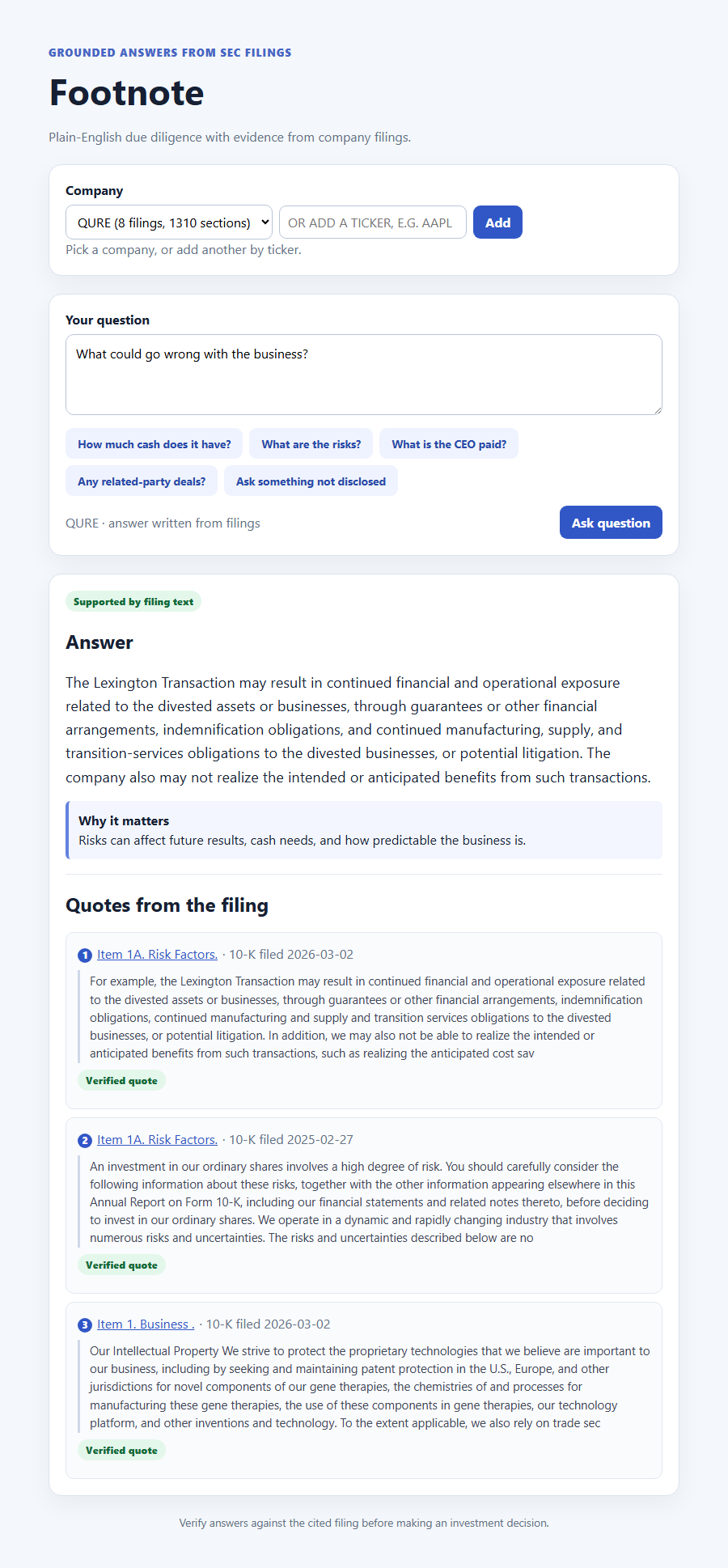
Ask a plain-English question about any US public company and get an answer built only from its SEC filings. It pulls filings from EDGAR on demand and retrieves with a hand-rolled mix of BM25 and vector search, no RAG framework underneath. Every quote is checked against the source before it’s shown, and if the filings don’t cover the question it says “not disclosed” instead of guessing. The eval set I built alongside it is what caught my abstention thresholds failing to generalize across companies.

The Footnote web app: a risk-factors question about QURE answered with a written summary and three verified quotes from its 10-K filings
Footnote answering a risk-factors question, with each quote checked against the cited 10-K before it’s shown. Scroll inside the frame for the full answer.
Independent Sept 2024 – June 2025

FridayFlicks

Spoken movie reviews, scored on-device
  • Android
  • Java
  • TensorFlow Lite
  • Speech-to-text

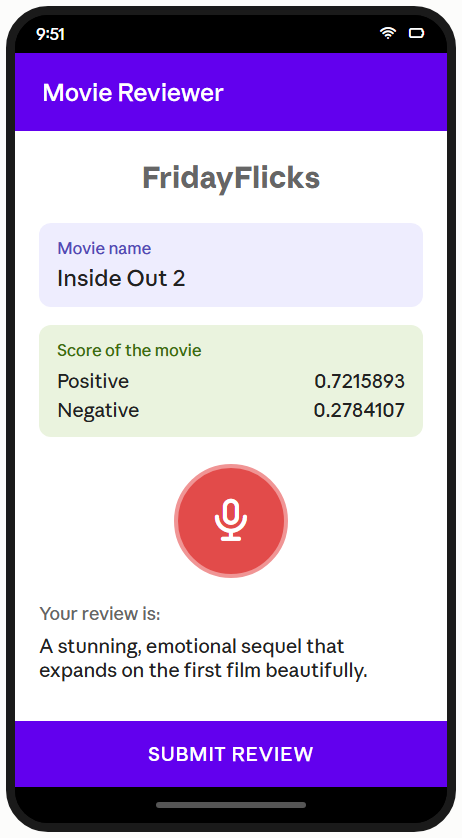
An Android app that turns a spoken movie review into a rating. It uses Google Assistant Service to transcribe what you say, then runs a TensorFlow Lite sentiment model on the phone to score it. The point was that the rating should come from your actual words, not a star you tap without thinking about it.

View the code on GitHub
FridayFlicks running on Android: a spoken movie review scored by sentiment
Team of 4 Spring 2022

WashU Bear Run

Unity arcade game, concept to deployment
  • Unity
  • C#
  • Game design

A small arcade game built in Unity and C#, start to finish. I led the team of four, ran the design calls, and put together the obstacle dodging, power-ups, and scoring.

Full-time & internships

Experience

Morningstar July 2023 – June 2026
Chicago, IL

Software Engineer

Morningstar Indexes

For three years I worked on Morningstar’s index data: the constituents, hedges, and FX rates that clients license and build products on. My job was connecting that data to the people who depend on it, both the clients receiving files and the operations team keeping the numbers right. On the bigger projects that meant starting with those teams to pin down what they needed, then scoping and building it myself in Java, Spring Boot, Hibernate, and React.

  • Owned Historical Bulk Delivery end to end. I gathered requirements from the operations and client-facing teams, scoped the build, and shipped it. Files now reach 1,000+ clients, and data entry dropped from days to minutes.
  • Built the Portfolio Observability page so operations could answer their own data questions. It puts index variants, constituents, hedge data, and FX rates in one view, with self-serve reload and recalculate, and it eliminated most of the 4–5 escalations a week that used to come to engineering.
  • Launched SmartX data delivery, a client-facing data offering that brings in about $50K a year. I worked with business stakeholders to align on delivery requirements, then built it in Spring Boot and HCL.
  • Consolidated 200+ index documents into one table on indexes.morningstar.com/resources so clients could find them without asking us.

Interactive recreation · try the tabs

Portfolio Global Equity Leaders Index
87Constituents
USDBase currency
Net TRIndex variant
Just nowLast recalculated
A replication of the Portfolio Observability page above, rebuilt from memory — same layout, tabs, and controls. The tabs and buttons work; every name and number is invented.
LB Networks June 2022 – Sept 2022
St. Louis, MO

Software UX Developer Intern

OcularIP

My first job with real customers on the other end. I worked on OcularIP 6.0.4, a network monitoring product used by 130 service providers, adding and fixing features in ReactJS and Material UI. I reworked the graphs on the Subscription Panel to be easier to read and cleaned up its buttons. Small stuff, but the kind of thing people using it every day would notice.

Ford June 2021 – Aug 2021
Shanghai, CN

Data Science Intern

Ford Lincoln, China

The Lincoln team kept asking one question: of everyone who walks into a showroom, who actually buys a car? I ran correlation analysis in SQL across 100,000+ prospective customers, looking at age, showroom visits, test drives, and other factors, and found the three that mattered most for conversion. Then I built a dashboard in ReactJS so managers could dig into it themselves instead of seeing the numbers once in a slide.

Yun-Chung (Eric) Liu

Contact

Get in touch

If you’re working on fintech, data infrastructure, or applied AI, I’d love to talk about Summer 2027 internships.

Outside of work, I’m usually on a basketball court, in the pool, or playing pickleball, and always up for a game of poker. If you just want to chat, I’d love to grab a coffee in New York, or a call works too. Reach out!